

SEBI Plans to Lower AIF Entry Barriers- Is Alternative Investing Becoming Mainstream?
The Regulatory Spark: Why SEBI is thinking AIF threshold
Over the last decade, India’s alternative investment landscape has been driven largely by Alternative Investment Funds (AIFs), which have grown fast, but not without constraints. High minimums, strict caps on investor count, and rigid mandates have kept many institutional and semi-institutional players at bay.
The Securities and Exchange Board of India (SEBI) in August 2025, has proposed that the minimum investment limit for Large Value Funds (LVFs) within the Alternative Investment Fund (AIF) be reduced from ₹70 crores to ₹25 crores, a 64% reduction in the entry threshold, to increase participation in the market while maintaining investor quality.
Key Regulatory Changes:
Previous Threshold: ₹70 crore for LVF
Proposed Threshold: ₹25 crore for LVFs
Standard AIF Minimum: ₹1 crore (unchanged)
Implementation: Subject to final approval
The rationale behind this move is practical. Institutional investors like insurance companies and pension funds face regulatory caps on single-fund exposure. A ₹70 crore minimum exhausts their allocation limits quickly, preventing portfolio diversification. The reduced threshold enables these investors to spread capital across multiple funds, improving risk management while supporting the industry's fundraising capabilities.
Prashant Sharma, Chief Investment Officer at a “Aviva Life Insurance” insurance company, explains the impact: "With the previous ₹70 crore threshold, we could only invest in 2-3 Large Value Funds within our regulatory limits. At ₹25 crore, we can diversify across 5-7 funds, significantly reducing concentration risk while accessing top-tier fund managers."
Market Analysis: Explosive Growth
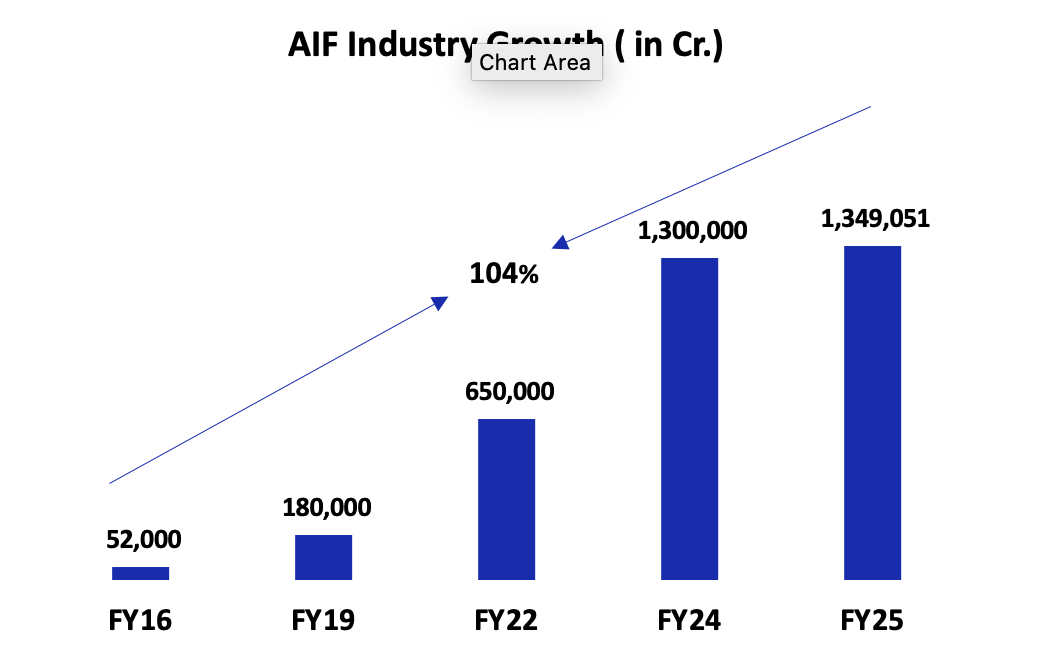
India's AIF industry has experienced remarkable expansion. From ₹530 crore in March 2013 to ₹13,49,051 crore by March 2025, the sector has grown 2,545 times in just over a decade. The compound annual growth rate of 28% between June 2019 and June 2024 significantly outpaces traditional investment vehicles.
Key Market Metrics:
Total AUM (2025): ₹13.5 Lakh Crore
CAGR (2019-24): 28%
Registered AIFs: 1,666+
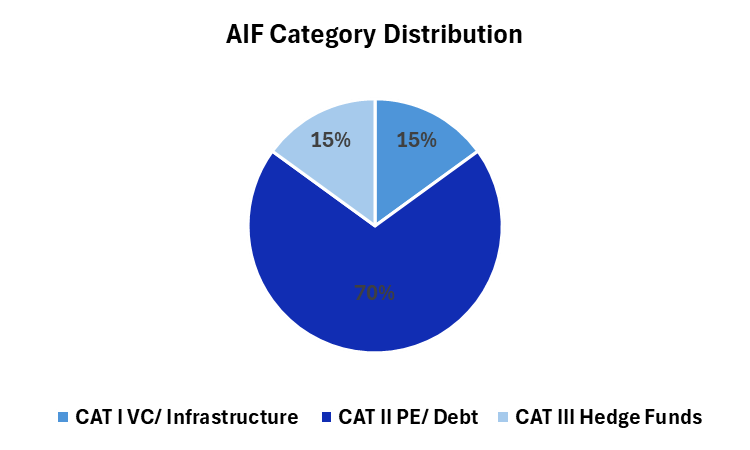
Category II AIFs, which include private equity and debt funds, dominate with approximately 70% of total assets. This preference reflects investor comfort with traditional alternative strategies over the complex derivatives and leverage used by Category III hedge funds.
Real-World Impact
An Indian insurance company with a ₹200 crore allocation for alternative investments faced constraints under the ₹70 crore minimum. They could only invest in 2-3 large value funds, creating concentration risk. After the reform with the ₹25 crore threshold, the same allocation can be spread across 6-8 funds, accessing diverse strategies including infrastructure debt, distressed assets, and growth equity while maintaining regulatory compliance.
The Mehta family office, managing ₹300 crore in assets, previously focused on mutual funds and direct equity. The founder's recent liquidity event sparked interest in alternative investments, but ₹70 crore represented 23% of their total portfolio, which is too concentrated for prudent diversification. The impact will be with ₹25 crore, they can allocate 8-10% per fund, accessing 3-4 specialized AIFs (venture capital, real estate, private credit) without excessive concentration.
Reality Check: Still Not Mainstream
Despite the reduced threshold, AIFs remain far from mainstream accessibility. To understand the context:
Investment Comparison Table:
 India's per capita income is approximately ₹2.5 lakh annually. An average upper-middle-class household manages savings of ₹50 lakh to ₹2 crore. The ₹25 crore threshold represents 125-500 times typical household wealth, placing it firmly in ultra-high net worth territory (0.001% of Indian households).
What's occurring isn't democratization in the inclusive sense—it's tiering within the wealthy class. The club that admitted only billionaires is now accepting multi-millionaires. Significant, but not mainstream.
Conclusion
SEBI's proposal represents regulatory evolution responding to market maturity. The ₹70 crore to ₹25 crore reduction addresses legitimate institutional constraints while preserving the sophisticated investor focus that defines alternative investments. Looking forward in the “shorter term,” say FY25-FY27 an increased institutional participation, improved fund diversification, and enhanced competition among fund managers is expected. While in “medium-term” say FY27-FY30, Industry projections suggest AIF/PMS assets could surpass ₹100 lakh crore, rivaling mutual funds, and in “Long-term”, the Potential introduction of "retail AIF" categories with ₹10-25 lakh minimums for specific strategies.
The CAGR growth demonstrates strong demand from those who've discovered alternatives. Equity AIFs have consistently outperformed public market benchmarks, with growth and late-stage funds generating 23.6% alpha over the BSE 200 TRI index as of March 2024, beating the index by 5.97% as per the CRISIL-oister report.
The verdict: Alternative investing is becoming normalized within India's wealthy class, but not mainstream for average investors. It's an important distinction.
0

74

0
Author
Diksha Kalra
Publish Date
04 Oct 2025
Last Updated
04 Oct 2025
Reading Time
4 mins
Share On


Table Of Content
The Regulatory Spark: Why SEBI is thinking AIF threshold
Market Analysis: Explosive Growth
Real-World Impact
Reality Check: Still Not Mainstream
Conclusion