
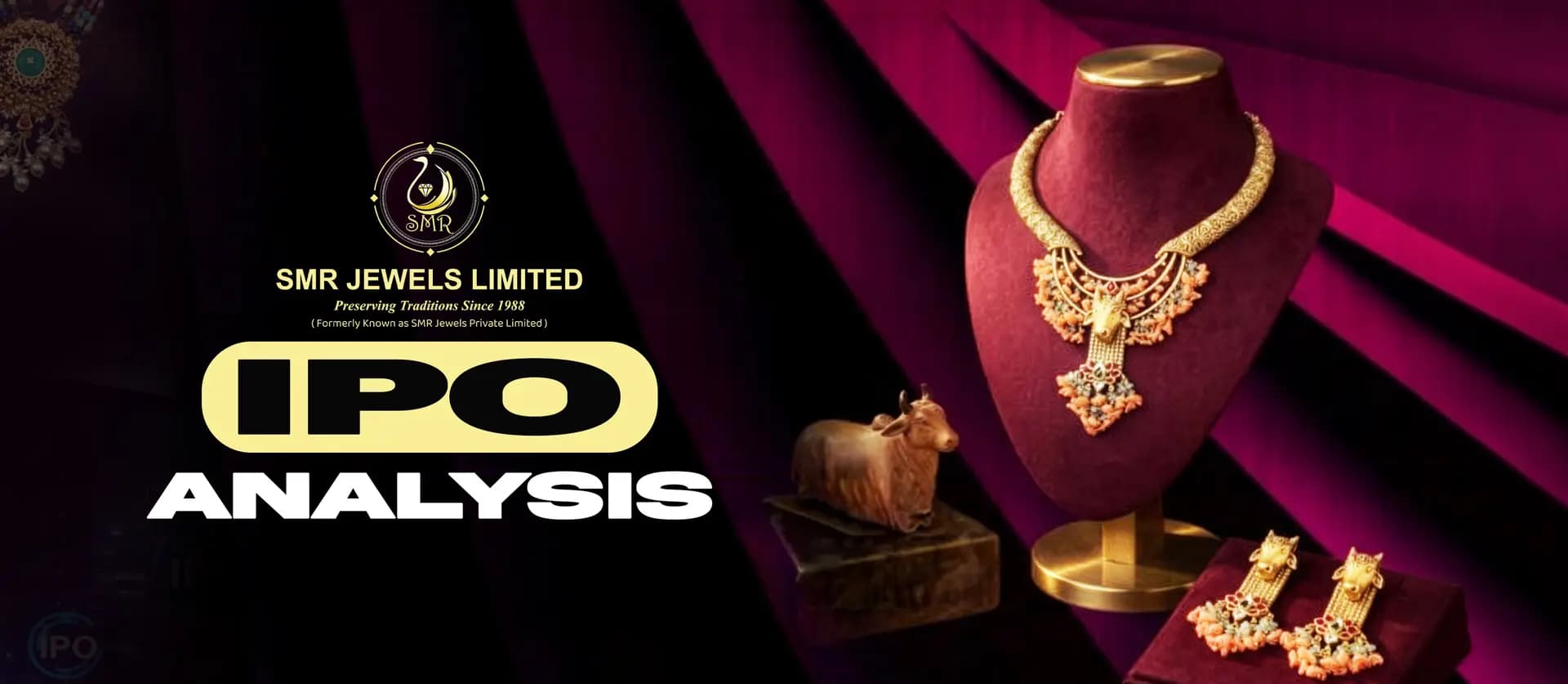
SMR Jewels IPO Review: A Detailed Analyst's Take on the ₹67 Crore BSE SME Issue Opening Today
Introduction
India’s jewellery market is gradually shifting from fragmented family-run businesses toward organised and design-driven players as consumers increasingly prefer branded collections, certified quality, and trusted retailers. Tapping into this evolving landscape, Ahmedabad-based SMR Jewels is entering the BSE SME platform with a ₹67 crore public issue.
Founded in 2018, SMR Jewels operates as a B2B jewellery design and distribution company catering to established retail jewellers across India. Rather than operating large showroom networks, the company follows an asset-light model focused on jewellery conceptualisation, outsourced manufacturing, and wholesale supply.
Its product portfolio includes bridal, antique, meenakari, polki, and customised heritage jewellery collections supplied to jewellery chains and regional retailers. This positioning allows the company to participate in India’s growing organised jewellery ecosystem without carrying the heavy fixed costs typically associated with retail-led jewellery businesses.
At the upper price band of ₹135 per share, the IPO appears relatively reasonably valued compared to certain listed jewellery peers on earnings multiples. However, investors should remain mindful of key SME risks including liquidity concerns, dependence on retailer relationships, working capital intensity, and exposure to fluctuations in gold prices.
SMR Jewels IPO Details at a Glance
The Product Portfolio
SMR Jewels operates across three distinct product verticals, each targeting specific occasions and consumer tastes:
Heritage Artistry Collection: Culturally rich, narrative-driven pieces inspired by India's spiritual and mythological heritage, Radha-Krishna motifs, Buddhist iconography, and temple-inspired designs. These are the marquee, high-value pieces sold during religious occasions, weddings, and gifting events.
Nature-Inspired Jewellery: Designs drawing from the natural world floral patterns, vines, seasonal themes, animals. A newer, aspirational product line targeting modern buyers who want traditional craftsmanship with contemporary aesthetics.
Traditional Jewellery: The core revenue driver. This includes Jadtar, Meenakari, Polki, and Bridal & Festive collections. These are the foundational products for the Indian wedding market, the single largest driver of jewellery purchases in India.
As of March 2026, the company had 23 permanent employees. But this lean headcount is by design more on that shortly.
The Business Model: Asset-Light by Choice
Here is where the story gets structurally interesting. SMR Jewels owns no manufacturing facility. Every piece of jewellery it sells is fabricated by an external network of skilled artisans and job-workers (Karigars), while design conceptualisation, quality oversight, and client relationships are managed internally. This is what is commonly called an asset-light model in B2B trade.
The value chain looks like this:
Gold/Raw Material Procurement → In-House Design Team → Outsourced Artisan/Karigar Network → Quality Check → B2B Supply to Retailer Chains
The company sources raw materials (predominantly gold), hands detailed design briefs to its Karigar network, receives finished goods, and supplies them to retail chains. Revenue is earned on the spread between the cost of fabrication and the realisation from B2B clients.
This model has two very significant implications. On the upside: extremely low fixed costs, no factory capex, no heavy depreciation, and therefore a structurally high Return on Equity which is exactly what the numbers show. On the downside: the company has no hard control over production quality, timelines, or scaling capacity. If a key artisan group faces disruption, the company cannot simply reroute production the next morning.
Key Clients: HSJ, Rokde Jewellers, WHP, JOSCO Jewellers, Kalamandir Jewellers, Vaibhav Jewellers, D.P. Abhushan Limited.
Customer Revenue Concentration
The concentration is rising year on year and this is the most important risk table in the entire prospectus.
Industry Overview
India's Gems and Jewellery sector contributes approximately 7% to the country's GDP and employs around 5 million people directly. It is one of India's most culturally embedded industries; the market was valued at $78.50 billion in FY21 and is projected to reach $100 billion by 2027. In FY25, Gems and Jewellery exports stood at ₹2,43,162 crore ($28.50 billion), with cumulative FDI inflows in the sector reaching ₹8,905 crore between April–December 2024 alone.
The sector is also in a structural transition. India has 450 organised jewellery manufacturers and exporters, and large retail chains: Kalamandir, Vaibhav Jewellers, Kalyan, Tanishq are actively consolidating their vendor base. They want consistent design capability, reliable supply, and quality control. This organised-to-organised supplier dynamic is the exact market SMR Jewels is positioned to serve.
India's Jewellery Market and the Current Headwinds
There is something quietly ironic about the timing of this IPO.
Two weeks ago, Prime Minister Narendra Modi stood before the nation and asked Indians to stop buying gold jewellery for at least a year. The appeal, framed around protecting India's foreign exchange reserves and reducing a $102 billion annual import bill, sent jewellery stocks tumbling within hours. Industry associations called it a threat to 3.5 crore livelihoods. Bullion traders warned of an "undeclared lockdown." The government, separately, raised the effective import duty on gold adding input cost pressure on top of a demand sentiment hit.
India imports 800-900 tonnes of gold every year, and roughly 60% of that goes directly into jewellery. The government's gold import duty now sits at 15%, one of the highest in its recent history. The PM's public appeal, while not legally binding, has historically moved sentiment measurably in a country where gold purchase is culturally tied to auspicious occasions and social signalling. Jewellery demand in India is not price-inelastic; high gold prices and negative sentiment have demonstrably softened volumes in the past.
SMR Jewels derives nearly its entire revenue from supplying bridal, heritage, and festive jewellery to retail chains like Kalamandir and Vaibhav Jewellers. Its end market is the Indian wedding consumer. If that consumer defers a purchase decision even by one season the knock-on effect travels up the supply chain to companies exactly like SMR. The company also procures gold as its primary raw material, meaning higher import duties directly inflate its cost of goods sold.
This is not a reason to avoid the IPO outright. Macro overhangs are temporary, and India's appetite for gold through weddings has historically been remarkably durable. But it is a reason to price in the near-term uncertainty honestly and to demand a meaningful growth runway before committing capital.
That tension between a compelling growth story and a difficult macro moment is exactly what this review tries to navigate. Because IPO analysis is not about picking the best time to invest. It is about understanding what you are buying, at what price, and whether the risk is worth taking.
This is not a company-specific risk. It is a sectoral headwind. But it is a live headwind that is relevant precisely at the time of this IPO.
Second, the Organised-to-Unorganised Transition (Long-Term Tailwind): Despite the near-term pressure, the long-term story for organised B2B suppliers remains intact. Large retail chains are consolidating supplier relationships, moving toward vendors with design capabilities, quality consistency, and reliable supply exactly what SMR positions itself as. The industry's secular growth trajectory, driven by a rising middle class and increasing wedding expenditure per event, supports the business model over a 3-5 year horizon.
Promoter and Management
SMR Jewels is a tightly controlled family business. All five promoters belong to two related Soni-family branches from Ahmedabad's jewellery community.
In simple terms, SMR Jewels is a family-run business. The promoters are Mr. Vismay Manojkumar Soni, Mr. Jainil Virendra Soni, Mrs. Parul Manoj Soni, Mrs. Dipikaben Virendra Soni, and Mrs. Drashti Pal Modi. The last three are mothers and a sister, respectively, of the first two this is a tight-knit family structure.
Vismay Manojkumar Soni (32) Managing Director: The central figure. Vismay holds an MBA in Integrated Management from IIPM Ahmedabad and carries over 12 years of experience in the gems and jewellery industry. Critically, the business predates the company's formal incorporation; it was run as a firm prior to 2018, and Vismay was actively engaged in its operations. This means the commercial track record is longer than the registered corporate history suggests. He oversees the overall management and growth strategy.
Jainil Virendra Soni (25) Whole-Time Director: Vismay's younger cousin, holds a BBA in Entrepreneurship and Family Business Management from GLS University, Ahmedabad. Five-plus years in jewellery. He handles operational execution.
Drashti Pal Modi CFO: Vismay's sister. She serves as the Chief Financial Officer. This is an important observation for governance analysis: the key financial oversight role is held by a family member, not an independent professional. This is common in SME businesses but is a standard governance concern for public market investors.
The Soni family's involvement in jewellery extends to three generations. The late Manojkumar Ramanlal Soni (Vismay's father) was active in the trade before him, and the family's network of artisans, suppliers, and institutional buyers has been built over decades. This kind of industry-specific social capital is difficult to replicate quickly and constitutes a genuine competitive advantage.
However, the Board's independent directors are relatively new and light on industry-specific experience. The independent director Ms. Nishita Sanghavi has 10 years in company secretarial work, and Ms. Ruta Soni has 3 years in ROC filings. Independent oversight of the business strategy is limited which is expected at the SME stage but is worth noting.
Post-IPO, the promoter group retains 65.74% collective control, a comfortable majority. Promoter dilution is from 90.37% to 65.74%, primarily through the fresh issue expanding total share count.
Related Party Transactions to Note:
The company has transactions with Ekatva Jewels, a firm owned by Niharika Vismay Soni (the MD's wife) goods sales of ₹25.06 lakhs and ₹34.11 lakhs in 9M FY26 and FY25 respectively, and purchases of ₹23.96 lakhs in 9M FY26. Rent is paid to promoter-directors Mrs. Parul Soni and Mrs. Dipikaben Soni (₹4.50 lakhs each). Promoter-family loans have been taken and repaid through FY23-FY26. A non-compete agreement exists with Ekatva Jewels. All transactions are disclosed and at arm's length per the RHP but investors in listed SME companies should track whether related-party volumes grow post-listing.
Financial Performance
*All figures sourced from Restated Financial Statements in the RHP dated May 18, 2026.*
Revenue has compounded at approximately 97% CAGR from FY23 to FY25 nearly doubling every year for two consecutive years. PAT has grown 11-fold. More importantly, margins are expanding consistently. EBITDA margin has tripled from 2.9% to 8.65% in approximately two years. This is not just the revenue scale the business is becoming structurally more profitable as it grows.
What is driving this? Three things working together. First, the company deepened existing client relationships. Average order size per customer jumped from ₹31 lakhs in FY24 to ₹115 lakhs in FY25. Second, the revenue mix shifted dramatically: traded goods fell from 34% of revenue in FY24 to just 1% in 9M FY26, with fabricated, value-added goods now comprising 99% of sales. Fabrication carries structurally higher margins. Third, operating leverage fixed costs (₹77 lakhs employees + ₹143 lakhs other expenses) spread over an ever-larger base drive margin expansion.
Key Financial Ratios
*Annualised basis
ROE declining from 87% to 43% is not a negative signal it reflects the equity base growing faster than earnings because of retained profits being ploughed back in. At 43-55% ROE on a growing equity base, this remains best-in-class capital efficiency. Debt-to-equity has collapsed from 6.10x to 0.39x in three years the business has organically delivered while tripling revenue.
Sector Specific Working Capital Ratios
Inventory days rising to 50 in 9M FY26 from 34 in FY25 is the most important red flag in the financials. More gold is being held for longer, which creates direct price-risk exposure. Debtor days are excellent and stable at 11-13 the company collects from B2B clients faster than most peers. Working capital cycle of 53 days on an annualised ₹41,000 lakh revenue base implies a working capital requirement of approximately ₹6,000 lakhs directly explaining why 55% of IPO proceeds go to working capital.
Cash Flow Statement
Operating cash flow is negative in three of four periods. In 9M FY26, despite ₹2,670 lakhs EBITDA, working capital consumed ₹3,865 lakhs primarily inventory build of ₹2,870 lakhs. Growth is consuming cash faster than the business generates it. The IPO capital is not optional, it is necessary to sustain current momentum.
Peer Analysis
Three things stand out clearly. SMR's revenue growth is the fastest in the peer group. Its ROCE and debt profile are the cleanest net debt is actually negative (more cash than debt). But Pushpa Jewellers, operating at a nearly identical revenue scale, runs EBITDA margins of 11.4% versus SMR's 5.76% and PAT margins of 7.93% versus SMR's 3.96%. The margin gap is real and significant. If SMR can close even half of that gap as it scales, earnings would nearly double without any additional revenue growth. That is the embedded upside in this investment thesis.
The customer concentration gap is equally stark, SMR at 62% versus Pushpa at 30%. This is the embedded risk.
SMR Jewels IPO Objectives
The fresh issue of ₹54 crore will be deployed as follows:
The ₹13.23 crore OFS goes directly to selling promoters. Working capital dominates because the business operationally requires it. The Jewellery Studio at Plot No. 306, Ahmedabad is a strategically interesting purpose-built facility for exhibitions and curated showcases that could unlock a future B2C-hybrid revenue stream.
Valuation Analysis
At 24x FY25 earnings, the issue is fully priced with no margin of safety on historical numbers. At 10x annualised 9M FY26 earnings, it looks genuinely attractive for a business growing this fast with 50% ROCE. The peer Pushpa Jewellers trades at a market cap implying 15-18x earnings at 10x forward, SMR offers a relative discount if growth sustains.
The investment thesis requires believing two things: that FY26's elevated run-rate continues into FY27, and that margins trend upward toward peer benchmarks. Both are plausible given the order book and mix shift. Neither is guaranteed given the macro headwind.
SMR Jewels IPO: Strengths & Risks
Strengths:
Revenue 97% CAGR (FY23–FY25) fastest growth in peer group
ROCE 47-50% and ROE 43-55% best-in-class capital efficiency
Asset-light model with near-zero fixed costs and minimal debt (D/E 0.39x)
Premium B2B clients: Kalamandir, Vaibhav Jewellers, JOSCO, D.P. Abhushan
Proprietary design library 500+ new designs launched in FY25 alone
Margin expansion story intact: EBITDA from 2.9% → 8.65% in two years
₹30+ crore order book as of December 2025 near-term visibility strong
Risks:
Top 10 customers = 62.43% of revenue with no long-term supply contracts
Entire production outsourced no manufacturing control, no production fallback
73% of revenue from Gujarat extreme geographic concentration
Operating cash flow negative in 3 of 4 periods not yet self-funding
Multiple ROC, GST, and income tax filing delays pattern of compliance lapses
PM Modi's gold purchase appeal + import duty hike = live demand headwind
OFS of ₹13.23 crore means partial promoter monetisation at IPO
CFO is a family member, not an independent professional hire
GMP & Subscription Sentiment
Grey Market Premium as of Day 1: ₹0. No premium, no discount, pure flatness.
This is an honest market read. There is no listing gain narrative here, no speculative excitement. Day 1 subscription data will be near-zero HNI and QIB investors always wait for Day 3. The real signal will come from the NII and QIB books on the final evening of subscription. Strong QIB participation would validate the fundamental case. A flat or under-subscribed QIB book would confirm the macro headwind is weighing on institutional appetite.
For investors applying for listing gains: this IPO does not present that case today.
Conclusion - The LMVT Framework
Leadership: The Soni family brings three generations of jewellery expertise, industry relationships, design understanding, and Karigar networks built over decades. Vismay Soni at 32 has already scaled this business 4x in two years. The concern is not competence; it is governance maturity. A family CFO, compliance delays, and related-party transactions with a family firm suggest the company is still operating at a private-business governance standard. That will need to change as a listed entity.
Moat: The moat here is narrower than it looks. The design library and artisan relationships are real assets, but they are not easily defensible. A well-funded competitor can hire designers and build artisan relationships. The stickiness comes from the combination of design quality, reliable supply, and B2B relationships. Once a retailer trusts a supplier, switching costs are real but not insurmountable. The moat exists today; whether it deepens or erodes will depend on execution.
Valuation: At 10x annualised forward earnings with 50% ROCE and a debt-negative balance sheet, the forward valuation is genuinely interesting. The catch is that FY25 numbers (24x P/E) already offer no safety margin, and the 9M FY26 run-rate needs to sustain in a softer demand environment to justify even the forward multiple. This is fairly valued to be modestly attractive, not cheap enough to buy on valuation alone, but not expensive enough to dismiss either.
Tailwinds: The long-term structural tailwind of India's growing wedding economy, the shift from unorganised to organised jewellery supply, rising per-occasion jewellery spend remains intact. The near-term headwind from government policy and gold sentiment is real and contemporaneous. An investor needs a 2-3 year time horizon to let the short-term noise dissipate and the structural story reassert itself.
Verdict: Cautious Apply – Long-Term, High-Risk Investors Only
SMR Jewels is a genuinely good growth story at a price that is reasonable if you look forward and full if you look back. The macro moment is poor, the governance needs upgrading, and the minimum ticket of ₹2.70 lakhs in an illiquid SME stock demands patience and surplus capital.
For listing gain seekers avoid. For aggressive, long-term investors with 2-3 year horizons, risk appetite, and surplus funds consider a measured position.
0

31

0
Share On


Table Of Content
Introduction
SMR Jewels IPO Details at a Glance
The Product Portfolio
India's Jewellery Market and the Current Headwinds
Financial Performance
Tags


